Inside Software 01.04.26 - What is keeping CMO's up at night

Every other week we’ll provide updates on the latest value levers and trends operators are asking us about in Technology and Software. If there are things you want to hear more about - shoot us a note.
HAPPY NEW YEAR!
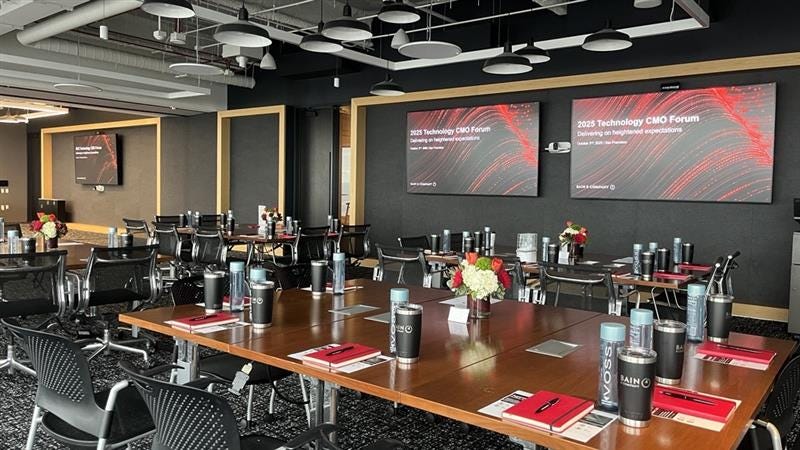
We recently wrapped our annual B2B CMO forum in San Francisco and it was a blast. We had leaders across the SW landscape—from multibillion dollar public companies to AI startups that are lighting the world on fire.
Despite differences in size, growth rate, public/private structure, or maturity, everyone is staring at the same reality: discovery is shifting to LLMs, clicks are down, insource vs outsource is a real question, (some) AI use cases are driving internal productivity (full list below), speed has become a moat, and the CMO job is changing. This note distills both the obvious and the nonobvious topics the leaders debated.
Excited by the forum? From time to time we have openings in our CXO forums—we may have a few seats in the M&A Forum (Feb 10, 2026), the Chief Product/Technology Officer Forum (March 5, 2025) and CRO Forum (Q2 2026). DM us if you’re a CXO and would like to be considered for the waitlist.
Key reflections from the executives
This is a leadership moment for the CMO. The GTM engine is changing fast—from how prospects discover you at the very top of the funnel to how frontline sellers are guided to the accounts and opportunities that matter most. This is a chance for the CMO to take a bigger seat at the table: work with your CEO and the rest of the executive team to shape the future GTM strategy across the entire funnel, from lead gen to purchase and expansion, and orchestrate Sales/CS, Product, and Data around a shared view of where growth will come from and how you’ll win it.
Speed is a moat (and it’s measurable). Several teams cut content cycle times by 50–80%, reduced time spent by 30–50%, and, in select areas, trimmed third-party spend by 50–75% after redesigning upstream workflows (“shift left”) and embedding AI in the process. The headline: process + AI + fewer signoffs beat tools alone.
Clicks are down, but conversion is up. Across the board, CMOs said that while they’re seeing clickthrough rates fall, they’re starting to see higher conversion from customers coming through LLM engines. Why? Customers are doing a lot more homework before they ever land on site, so when they show up, they’re already much deeper in the buying journey. This was a big unlock, and it pushed teams to rethink how they measure marketing effectiveness: buyers now do more of the journey in LLMs and show up later in your funnel, so traditional “last click” and channel-based attribution no longer tell the full story. CMOs are rebuilding telemetry to measure both traditional search activation and LLM sourced.
Be on the Day 1 list by becoming “category famous.” Modern buying journeys start long before a prospect ever fills out a form or talks to a rep. Most B2B buyers already have a Day 1 list of 2–4 vendors in mind, and the vast majority (over 90%) end up choosing from that shortlist. In an LLM world, you don’t buy your way onto that list; you earn it by becoming category famous—showing up consistently as a credible, low-risk choice across your own sites, user communities, and third-party referrals. The CMO’s job is to know what the Day 1 list looks like in their category and shape brand, content, and community so both humans and LLMs put their company on it.
Two operating models are emerging. There are really two paths going forward. Marketing budgets will stay under pressure, so CMOs are choosing between: (1) insourcing the innovation engine to internal teams—the team owns more of the end-to-end work (brief design, creative development, campaign execution, rapid prototyping) and selectively outsources to agencies where the inhouse team doesn’t play; or (2) cutting down the internal team with scaled agency support, essentially outsourcing both innovation and activation engines, with the internal org focused on the highest priority bets, governance, and integration.
Design for two journeys—agents and humans—on one site. CMOs kept coming back to two truths: (1) you still have to deliver a great human experience on site—compelling videos, references, demos, and deep product content; and (2) that same human designed site is not how agents want to consume information. Agents prefer structured inputs: canonical answers, FAQs, integration docs, community pages, and clear reference architectures. Teams in the room were experimenting with ways to create two experiences off the same backbone—sometimes even forking traffic between a more conversational, bot led experience and the traditional human site. Both journeys will matter over the long term; the key is to design them intentionally rather than letting either one emerge by accident.
High-quality content is your future “model fuel.” In the past, marketers sweated over getting CDP/Customer360 right. In an LLM world, that still matters—but having a high-quality digital asset repository (your “content kernel”) becomes just as critical. Clear, differentiated content about what you sell, why you win vs. competitors, and how customers use your product is what LLMs will ingest, replicate, and personalize at scale. High-quality content becomes the rocket fuel that powers the next generation of marketing performance.
Measure outcomes that matter and scale deliberately. Most pilots meet or exceed expectations, but less than half create quantifiable revenue or cost impact at first pass. Instrument leading and lagging indicators, choose whether a pilot is aimed at revenue or cost (deployment differs), and only scale what moves the numbers.
Extra Credit:
For benchmarking, we crowdsourced in-the-room which AI use cases CMOs were testing today (NOT exhaustive). There were varying levels of maturity and success, but helpful inspiration for marketers out there.
Language (with a human‑in‑the‑loop)
Blog (copywriting & edits)
NPD – New Product Development
Research (industry trends; “Evidensa?” noted)
Asset reproduction / small editing
Image generation
Lead routing / scoring
Buyer personas (research → audience inputs) + stories around personas
Data enrichment / Data tagging
Marketing workflows
Inbound SDR (working) + Outbound
Round‑1 demos
Video editing
Podcasts
Compliance / Brand Guidelines / Legal (custom build)
Note: The opinions expressed in this article are my own and do not represent the views or specific recruiting practices of Bain & Company. The information provided is believed to be from reliable sources but no liability is accepted for any inaccuracies.