Inside Software 01.18.26 - The Rise (and Real Variations) of the Forward Deployed Engineer

Every other week we’ll provide updates on the latest value levers and trends operators are asking us about in Technology and Software. If there are things you want to hear more about - shoot us a note.
In the words of my teenagers, Forward Deployed Engineers (FDEs) are “eating it up, and leaving no crumbs.” Not because the title is cool (it is), but because the problem they are solving is real: more software is transformative, priced to value, and sold to executives who need outcomes—not feature tours. And when the product changes how work gets done (AI agents, automation, “new ways of working”), the gap between “signed contract” and “real production impact” gets painfully wide. The companies leaning into FDEs are basically acknowledging a simple truth: if adoption is hard, delivery becomes the product.
So…what is a Forward Deployed Engineer?
In plain English: an FDE is an engineer who embeds with customers to make the product real in their environment—often stitching together technical build, workflow design, and on-the-ground problem solving.
In the purest form (Palantir), the FDE is the “hero” brought into every deal and carries accountability across pre-sale and post-sale: drive the sale, accelerate adoption, build production use cases, and set the account up for expansion. Palantir’s model is so end-to-end that the FDE effectively replaces chunks of classic pre-sales engineering, professional services, and even customer success.
It is definitely all the rage - since January 2024, the number of “Forward Deployed Engineer” titles on LinkedIn has doubled! With excitement also comes caution - these roles are not cheap. Early-career FDE compensation often lands in the $150–200K range, while senior profiles can reach ~$300–400K (with heavy RSUs), reflecting the rare blend of software engineering + ambiguity tolerance + customer-facing horsepower.
The four FDE operating models we actually see in the wild
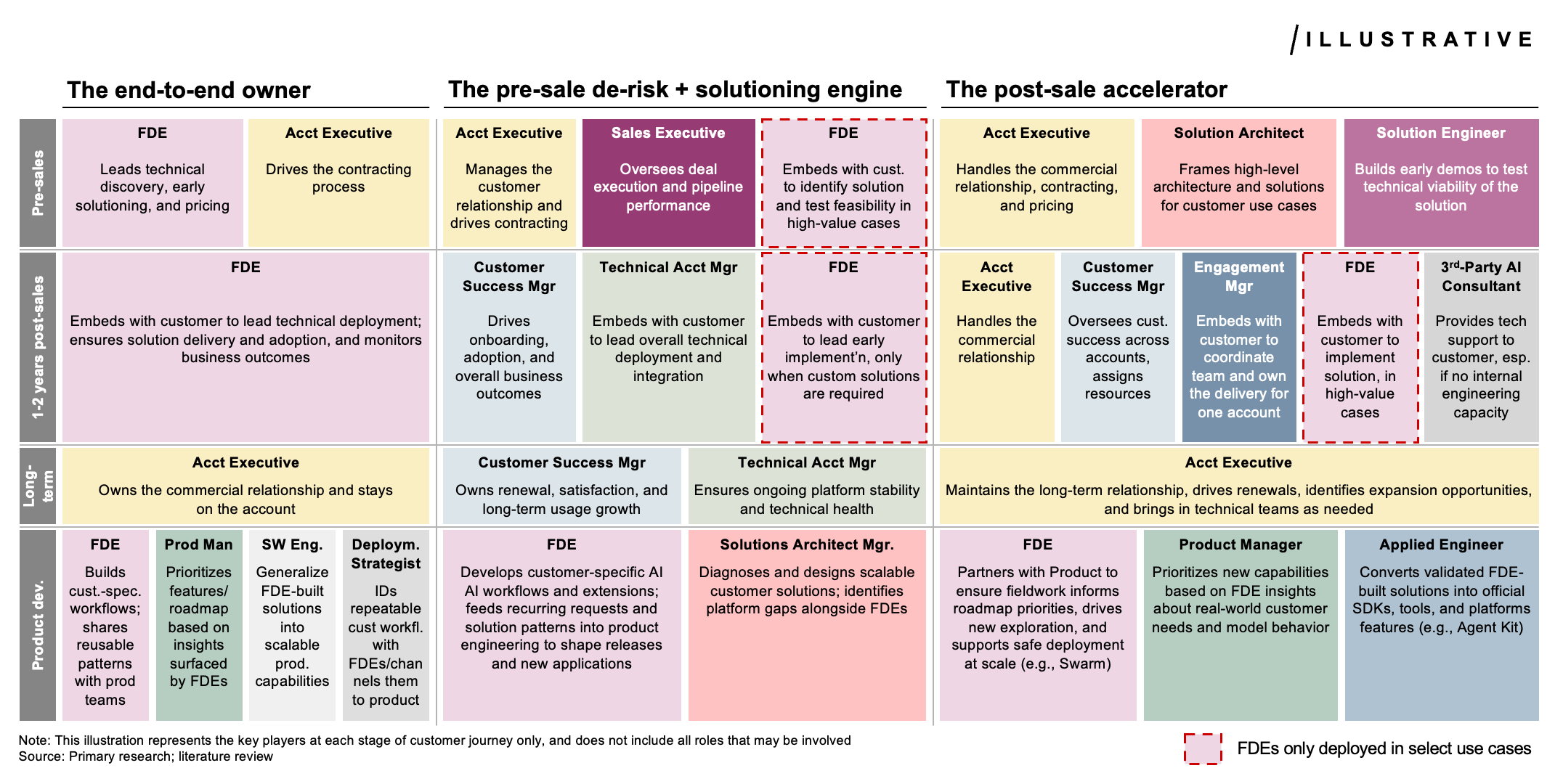
Our benchmarking shows that while “Forward Deployed Engineer” is a common label, it can oversimplify what are actually multiple operating models. The cleanest way to think about the spectrum is: where do FDEs show up in the lifecycle—and what are they accountable for?
1) The end-to-end owner (the Palantir extreme)
This is the purest model: FDEs are the single-threaded owner from discovery to production outcomes, carrying context across the full lifecycle and feeding learnings back into R&D. Palantir has leaned in hard—FDEs are ~20% of the workforce—and teams scale from small “pilot” squads (often an FDE + deployment strategist) into larger enterprise pods as the revenue opportunity grows.
2) The pre-sale de-risk + solutioning engine (Scale AI)
Here, FDEs show up early to turn “this could work” into a credible technical plan—and a credible value story. Scale pairs this with a tiered FDE ladder, domain alignment, and explicit outcomes. The punchline: renewal performance is meaningfully higher when an FDE is deployed (roughly ~85% with vs. ~65% without), and teams can scale up to ~8 FDEs on larger projects.
3) The post-sale accelerator (common in AI, exemplified by OpenAI)
In this model, you keep a more traditional pre-sales motion up front, then deploy FDEs post-sale when value delivery needs to be de-risked: integration, custom solution build-out, and turning early wins into repeatable patterns that can inform the roadmap.
4) The applied engineering “wedge” (Microsoft and Sierra)
These teams are often time-boxed and designed to unlock production adoption fast. Microsoft’s Applied Engineering runs 3–6 month cycles from envisioning → PoC → MVP → early production, then frequently hands longer-term implementation to partners. Sierra highlights a pragmatic variant: lighter customers can be served by PM-led implementation, while more complex deployments pull in deeper engineering.
One more nuance: most companies gate FDE deployment. Even if they have the capability, they reserve it for the situations where ROI is clear—strategic accounts, regulated environments, novel AI-first use cases, complex transformations, or moments where executive buy-in is the fragile dependency.
(If you want the benchmarking visual, shoot us a note—we’re happy to share.)
Where FDEs go wrong (and how to prevent it)
For all the compelling examples above, it’s worth stating the quiet part out loud: the FDE model is incredibly easy to get almost right… and still fail.
Most FDE efforts break for boring reasons:
Unclear charter: Are they there to sell, build, implement, or “do whatever it takes”? If the answer is “yes,” you’ll get chaos.
Role collision: FDEs overlap with SE, PS, CS, and even Product. Without crisp swim lanes, you’ll burn political capital internally while confusing customers.
One-off heroics: If great work in the field never gets productized—and you don’t codify the learnings into reusable playbooks, templates, and patterns—you’ve built the world’s most expensive bespoke services motion. The result is one-off innovation on a project-by-project basis, with no ability to centralize what works and scale it across customers.
The fixes are equally practical: clear gating criteria, explicit handoffs, and a mechanism to turn repeatable patterns into product (with metrics like time-to-first-value, production adoption, and “field → product” conversion rate).
How to start without betting the company
A simple launch pattern: pick 1–2 high-value segments, run a gated FDE pool, and define a tight 90-day definition of success (e.g., win-rate lift, time-to-production, renewal lift, attach on expansion). If the team can’t prove ROI quickly, the model will sprawl—and you’ll end up with the most expensive “implementation team” you’ve ever built.
The executive checklist: should we build an FDE capability?
The role is powerful—but it changes your GTM economics, your delivery model, and often your packaging. Here are the questions we’d push leadership teams to answer before they start hiring:
Strategy + scope
What’s the objective: faster adoption, higher win rates, de-risking AI value delivery, standardizing repeatable use cases, a stronger customer flywheel?
Which products / solutions truly justify this cost (i.e., where benefit outweighs the expense)?
Are FDEs end-to-end owners (Palantir) or a gated accelerator for specific situations?
Commercial model
Which customers qualify (deal size, value at stake, strategic importance)—and for how long do they get an FDE?
Who sells it and how do you position it without turning your product into “software + people”?
How do you price it (explicitly, bundled, outcome/usage-based)—and does the math work for your business? We’ve found FDEs make the most financial sense when (1) they de-risk outcome-based pricing so you can capture a meaningfully higher share of the ROI, and/or (2) you can fold the cost into SaaS economics—taking a profitability hit during implementation but protecting long-term software margins (vs. drifting into services margins). In the second case, the FDE motion starts to look like the continued evolution (or, more cynically, the trendy rebrand) of the paid CSM/TAM companies have been building for the past decade.
Operating model + talent
Where do they report (product, engineering, GTM)? What incentives prevent them from becoming “hero coders” who build one-offs that never scale?
What’s the training path—and what are the “graduation criteria” for turning repeatable patterns into product features?
Note: The opinions expressed in this article are my own and do not represent the views or specific recruiting practices of Bain & Company. The information provided is believed to be from reliable sources but no liability is accepted for any inaccuracies.